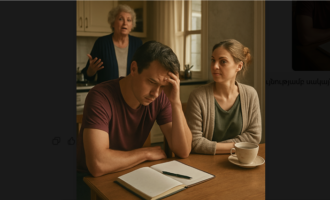
The apartment door swung open with such a bang that a framed photograph fell from the wall. The glass shattered into a thousand tiny pieces right at Svetlana’s feet, who stood frozen with a cup of half-drunk coffee in her hands.
“Pack your things! Now!” the mother-in-law burst into the apartment like a hurricane, followed by a notary in a shabby suit, holding a thick folder of documents.
Svetlana slowly placed her cup on the table. Her hands didn’t shake. She’d been waiting for this moment for three years, ever since Andrei’s motorcycle accident. For three years, her mother-in-law, Raisa Petrovna, had pretended she didn’t exist. And now she’d shown up. With a notary.
“This apartment belongs to my son, and that means it belongs to me!” Raisa Petrovna glanced around the living room, as if already figuring out where to put her favorite bookcase. “You have an hour to get ready. And don’t even think about taking any of Andrei’s things!”
The notary coughed awkwardly, adjusted his glasses, and unfolded the document.
“According to the will of the late Andrei Viktorovich Semyonov, drawn up two weeks before his death…”
Svetlana felt something in her chest sink. The will? Two weeks before the accident? They’d had a falling out over his mother, who’d once again demanded they move in with her. Andrey had slammed the door and gone to his mother’s for three days. Could he really…
“All property goes to the sole heir—my mother, Raisa Petrovna Semyonova,” the notary read monotonously.
Svetlana sat down on the sofa. Her legs buckled, not from grief, but from the realization of the scale of the betrayal. Her husband, with whom they’d lived for seven years, with whom they’d planned to have children, with whom they’d paid the mortgage on this very apartment… He’d made a will in favor of her mother after a routine family squabble.
“The hour’s up!” Raisa Petrovna pointedly glanced at her watch. “And you’ll leave the keys on the table. All the sets!”
Svetlana stood up. A strange, frightening determination appeared in her movements. She walked past her mother-in-law without looking at her and headed for the bedroom. Raisa Petrovna chuckled contentedly—her daughter-in-law had given in more easily than she’d expected.
But Svetlana wasn’t packing. She opened the closet and pulled a small box from the far corner. Inside were documents. She sifted through them calmly, methodically. The apartment purchase agreement. Mortgage payment receipts. Her personal account statements. Over seven years, she’d invested more than two million rubles in this apartment—her salary as a nurse at a private clinic. Andrey was just starting his business then, they had no money, and she was practically single-handedly paying the mortgage.
She returned to the living room with a folder of documents. Raisa Petrovna was already busy, opening cabinets and checking the contents.
“Raisa Petrovna,” Svetlana’s voice was calm, almost too calm. “Look here.”
She fanned the documents out on the table, like a croupier laying out cards.
“Here’s the sales contract. The apartment is registered to Andrey, that’s true. But here are the payment receipts. All from my account. Two million three hundred thousand over four years. Here are the bank statements. Here’s my employment contract confirming my income.”
Raisa Petrovna shrugged.
“So what? You helped him as his wife. That was your duty. And the apartment is registered to him. And the will is in my favor. So get ready!”
The notary cleared his throat again, clearly uncomfortable.
“Actually, if a wife can prove her financial contribution to the purchase of the property…”
“Shut up!” Raisa Petrovna barked at him. “You’ve done your job, go!”
But the notary didn’t leave. He carefully studied Svetlana’s documents, shook his head, and muttered something under his breath. “You know, Raisa Petrovna,” he finally said. “This situation is ambiguous. The court could recognize Svetlana Igorevna’s right to a share in the apartment. Considering the documented payments…”
“What court?!” the mother-in-law shrieked. “I have a will!”
Svetlana put the documents back in the folder. She was still calm, but a strange glint appeared in her eyes.
“Raisa Petrovna, I propose a peaceful settlement. You take your share—half of the apartment—by right of inheritance. I keep my half—by right of payment. We sell the apartment and separate.”
“No way!” the mother-in-law flushed. “This is my son’s apartment! My only son’s! You won’t get a penny!”
Svetlana nodded, as if she’d expected exactly that answer.
“Okay. Then I’ll see you in court. In the meantime, I’ll stay here. This is my home too.” “How can you stay?!” Raisa Petrovna turned to the notary. “Do something!”
The notary shrugged.
“I can’t evict someone from an apartment in which they’ve invested documented funds. Only the court can decide that.”
The next few days turned into hell. Raisa Petrovna didn’t leave—she declared she’d be living in her son’s apartment. She took over the bedroom, throwing out Svetlana’s things. Svetlana, without a fuss, moved into the living room, onto the sofa.
The mother-in-law began a systematic siege. She’d get up at five in the morning and bang dishes around the kitchen. She’d turn the television on full blast. She’d invite her friends over, who’d sit in the kitchen for hours, loudly discussing how ungrateful Svetlana was and how she was tormenting an elderly woman who’d lost her only son.
“Look at her!” Raisa Petrovna wailed as Svetlana passed by. “She wants to force me out of my son’s apartment! She has no shame, no conscience!”
Her friends shook their heads sympathetically, casting disapproving glances at Svetlana.
Svetlana remained silent. She left for work early in the morning and returned late at night. She ate at a cafe near the clinic. She only came home to sleep.
But Raisa Petrovna found a way to get to her even here. She started calling the clinic where Svetlana worked. She complained to the head doctor that her daughter-in-law was starving her, not letting her into the kitchen, and threatening her.
“Svetlana Igorevna,” the head doctor called her in after the third call. “What’s going on at home? Your mother-in-law is calling, crying…”
“She’s trying to take away the apartment I invested all my money in,” Svetlana replied calmly. “The trial is in session.”
The head doctor frowned.
“I understand the situation is complicated. But the clinic’s reputation… If she starts filing complaints with the Department of Health…”
Svetlana nodded. She understood everything. Raisa Petrovna was hitting all the right buttons.
That evening, Svetlana returned home and discovered the lock had been changed. Her key didn’t fit. She rang the doorbell. No one answered, though she heard footsteps outside.
She called a locksmith and showed him the apartment documents. While he was changing the lock, Raisa Petrovna’s hysterical screams could be heard from behind the door, claiming she was being robbed and that she would call the police.
The police arrived an hour later. Two tired sergeants listened to both sides, looked at the documents, and shrugged.
“It’s a civil dispute. Resolve it in court. In the meantime, you both have the right to be in the apartment.”
This went on for two months. A war of attrition. Raisa Petrovna resorted to every method: filing complaints, creating scandals, even trying to call an ambulance by faking a heart attack when Svetlana refused to give her the keys to the new locks.
The trial was scheduled for the end of the third month. The day before the hearing, Svetlana returned home and found a strange man in the living room. A robust man, about thirty-five years old, wearing a tracksuit.
“This is my nephew, Viktor,” Raisa Petrovna said contentedly. “He will live here and help me. And you can sleep in the kitchen. Or leave altogether, which would be better.”
Victor grinned, demonstratively lounging on the sofa—the very same one where Svetlana slept.
“Aunt Raya told me everything. It’s not nice to offend elderly people.”
Svetlana looked at him, then at her mother-in-law. Raisa Petrovna’s eyes danced with triumph. She was sure her daughter-in-law would give in now.
Svetlana pulled out her phone.
“Hello, Mikhail? This is Svetlana. Remember, you offered to help? I need security. Yes, right now. Thank you.”
Mikhail was her colleague’s brother, the owner of a security agency. Forty minutes later, two sturdy men in formal suits entered the apartment.
“This citizen has illegally entered my home,” Svetlana said calmly, pointing at Victor. “Please remove him.”
Victor jumped up, but he had no chance against two professionals. They literally carried him out of the apartment, despite Raisa Petrovna’s screams.
“From now on, you will be on duty here in shifts,” Svetlana told the guards. “Until the court’s decision. This woman has the right to be here, but she is not to let anyone else in.”
Raisa Petrovna choked with indignation. “You… you have no right! This is my son’s apartment!”
“Tomorrow the court will decide whose apartment it is,” Svetlana replied.
On the day of the trial, Raisa Petrovna arrived surrounded by an entire entourage—two friends, her nephew Viktor, and a dubious-looking lawyer. Svetlana was alone, carrying only a folder of documents.
The judge, a woman of about fifty with a tired expression, carefully examined all the papers. The will. The payment documents. The bank statements.
“Mrs. Semenova,” she turned to Raisa Petrovna. “Are you claiming you have the right to the entire apartment according to the will?”
“Of course! My son left everything to me! This woman simply lived with him, taking advantage of his kindness!”
The judge turned to Svetlana.
“And you, Ms. Semenova, claim you invested your own funds in the purchase of the apartment?”
“Two million, three hundred thousand rubles over four years. Here are all the documents.”
The judge nodded.
“I’ve reviewed the case materials. The situation is indeed ambiguous. On the one hand, there’s a will. On the other, there’s documented financial contributions from the wife. However…”
She paused, and silence fell in the courtroom.
“However, I noticed the date the will was made. Two weeks before Andrei Semenov’s death. Ms. Semenova Sr., can you explain the circumstances under which this will was made?”
Raisa Petrovna hesitated.
“Well… my son came to see me. He said he wanted to formalize everything. Just in case.”
“Just in case?” the judge raised her eyebrows. “A young, healthy, thirty-two-year-old man suddenly decided to make a will?”
“What’s so special about that?” Raisa Petrovna’s lawyer interjected. “Anyone has the right…”
“Yes,” the judge agreed. “But I have questions. Is the notary who certified the will present?”
The notary in the shabby suit rose from the courtroom.
“Tell me the circumstances of the will.”
The notary nervously adjusted his glasses.
“Mr. Semyonov came with his mother. He said he wanted to leave everything to her. I drew up the documents.”
“Was he alone? Or with his mother?”
“With his mother. She… she helped formulate the clauses.”
The judge nodded and turned back to Svetlana.
“Do you have anything to add?”
Svetlana stood up.
“Two weeks before the will was drawn up, my husband and I had a fight. It was caused by his mother’s demand that we sell the apartment and move in with her. I refused. Andrei went to his mother’s for three days. Apparently, that’s when the will was drawn up. But then he returned, and we reconciled. He said he regretted the fight. The day before he died, we were discussing renovating the nursery. We were planning to have a baby.”
Her voice wavered for the first time. The judge looked at her sympathetically.
“So you’re saying the will was drawn up in a fit of passion, under the influence of his mother?”
“That’s a lie!” Raisa Petrovna screamed. “My son decided everything himself! He knew I was alone, that I needed support!”
“Do you have your own apartment?” the judge asked.
“Yes, but it’s small, a one-room apartment…”
“A pension?”
“Thirty-two thousand…”
“And you?” the judge turned to Svetlana.
“After my husband’s death, only my salary. Fifty thousand. I don’t have my own place. I’m from another city; I moved here after I got married.”
The judge delved into the documents. Ten minutes of awkward silence passed.
“Having heard the parties and reviewed the case materials, the court orders,” the judge spoke loudly and clearly. “To recognize Svetlana Igorevna Semenova’s right to half of the disputed apartment as the spouse who invested documented funds in its acquisition. The other half is inherited by Raisa Petrovna Semenova. The parties may agree to buy out the share or sell the apartment and divide the funds.”
Raisa Petrovna jumped up.
“That’s unfair! This is my son’s apartment!”
“The decision can be appealed in the prescribed manner,” the judge replied dryly. “The hearing is over.”
As they were leaving the courtroom, Raisa Petrovna caught up with Svetlana.
“You think you’ve won? I’ll live in this apartment! I’ll make your life a living hell! You’ll beg for mercy yourself!”
Svetlana stopped and turned to her.
“Raisa Petrovna, I’m selling my share. You can buy it back if you have the money. If not, I’ll sell it to the first buyer. And yes, the new owner probably won’t want to live in the same apartment with you. So think fast.”
She turned and walked away without looking back. Behind her, she could hear her mother-in-law’s hysterical screams, but Svetlana no longer listened.
A month later, the apartment was sold. Raisa Petrovna couldn’t find the money to buy out her daughter-in-law’s share. The buyer, a young family with two children, offered a good price for the entire apartment. Her mother-in-law was forced to accept.
On the day the money arrived, Svetlana met Raisa Petrovna at the bank. She looked aged and haggard. Neither her nephew nor her friends were with her.
“Satisfied?” she hissed. “You took away the memory of my son!”
Svetlana shook her head.
“I didn’t take it away, Raisa Petrovna. You destroyed everything yourself. We could have kept this apartment together, as a memory of Andrei. But you chose war. And in war, there are no winners, only survivors.”
She signed the final documents and left the bank. She had enough money in her account to start a new life. In a different city, where no one knew her story.
And Raisa Petrovna remained standing in the bank lobby, clutching the documents confirming her half of the family’s estate. The victory she had so craved proved Pyrrhic. The apartment was gone. Her daughter-in-law had left. And nothing remained of her son except the money in the account and a photograph in a broken frame, which she had picked up the day she broke into the apartment with the notary.
Only now, looking at this photograph of Andrei hugging Svetlana, both of them smiling, did Raisa Petrovna understand what she had done. She had wanted to keep her son for herself, but she had lost the last thing that remained of him—the woman he loved and who loved him.
Svetlana left a week later. A new job in Moscow, a rented apartment, a clean slate. She took with her only one thing from her past life—a small photograph of Andrei, which she kept in a locket. Not as a memento of the betrayal with the will, but as a reminder of the seven years of true love they shared before his mother decided she had the right to everything.
The story became famous in their town. Neighbors, acquaintances, even Raisa Petrovna’s friends shook their heads in disapproval. Greed and the desire to control everything had left the elderly woman alone, with money but no family.
And Svetlana began a new life. A year later, she met a man who didn’t have an overbearing mother. They married and had two children. And when her new mother-in-law, a sweet, intelligent woman, came to visit, Svetlana greeted her with genuine joy.
Sometimes, very rarely, she recalled that story with the apartment. And every time, she thought: how much grief could have been avoided if Raisa Petrovna had simply accepted her as a daughter, and not as a rival. But some lessons are learned too late, when there’s nothing left to fix.