Before the First Note
The auditorium was full, but no one was speaking loudly.
There were only soft whispers, the sound of clothes brushing against chairs, a few seats moving, and the quiet hum of the stage lights above. The audience sat in darkness, while a bright circle of white light waited in the middle of the stage for one small child.
Her name was Mila.
She was only five years old.
In the middle of that large stage, she looked tiny. Her shiny shoes reflected the light. Her pale blue dress trembled slightly every time she breathed. In both of her small hands, she held a microphone that almost looked too big for her.
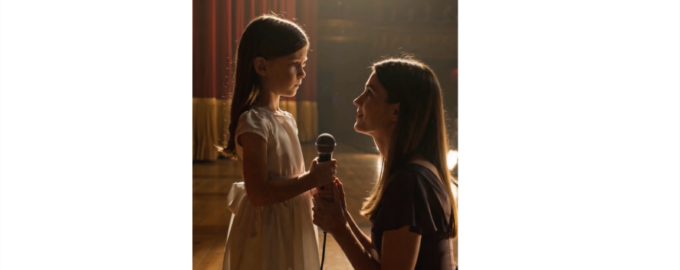
In front of her, kneeling on the stage, was a young woman around twenty years old. Her name was Clara. Her hair was tied back in a hurry, her face looked tired, but her smile was warm and gentle. She placed both hands softly on Mila’s arms, trying to calm her.
The little girl had not started singing yet.
She was looking at the audience with frightened eyes.
Clara leaned closer and whispered, loud enough for the microphone to catch her words:
“Come on, sweetheart… sing from your heart and make this whole room remember your voice.”
A deeper silence fell over the audience.
Mila swallowed nervously. Her little fingers tightened around the microphone. She looked at Clara, then at the hundreds of faces hidden in the dark. Everything felt enormous: the stage, the lights, the silence, the waiting eyes.
Clara smiled again.
“I’m right here, okay? You’re not alone.”
But Mila did not answer.
Her lips trembled.
And just as she took a deep breath, just before her voice was supposed to come out, it felt as if her whole life was hanging in that one silent second.
No one in that room knew why this moment mattered so much.
No one except Clara.
A few months earlier, Mila never sang in front of people.
At home, it was different. Sometimes she sang quietly while arranging her colored pencils, playing with her doll, or watching the rain slide down the window. Her voice was soft and delicate, like a small light in a dark room.
But whenever an adult asked her to sing, she froze. She lowered her eyes, hid her hands behind her back, and shook her head.
Clara understood that fear.
She had seen it grow inside Mila after their mother passed away.
Clara was only twenty, but she felt much older. Since their mother was gone, she had taken care of her little sister as best as she could. Their apartment was small, the bills came too quickly, and the days always seemed too short.
Every morning, Clara took Mila to kindergarten. Then she ran to her job at a small bakery. In the evening, she came home tired, cooked dinner, checked Mila’s drawings, washed clothes, cleaned the kitchen, and tried to smile even when she wanted to cry.
Mila noticed everything.
She saw the dark circles under Clara’s eyes. She saw her sister counting coins in a little bowl near the window. She also saw Clara sitting on the edge of the bed late at night, holding an old photo of their mother.
But Mila said nothing.
She was too young to understand everything, but old enough to feel that their life had changed.
One evening, while Clara was folding clothes in the living room, Mila came to her with a paper in her hand.
“What is it, sweetheart?” Clara asked.
Mila gave her the paper.
It was a flyer from school. It announced a children’s talent evening at the city auditorium. Children could go on stage to sing, recite a poem, or tell a short story. The winner would receive a scholarship for one year of art lessons.
Clara read the flyer quietly.
“Do you want to go watch the show?”
Mila shook her head.
“I want to sing.”
Clara froze.
“You want to sing… on stage?”
Mila nodded slowly.
Clara put the clothes aside.
“Are you sure?”
The little girl looked down.
“Mom said my voice was like a star.”
Clara felt her throat tighten.
Their mother really used to say that. Whenever Mila sang in the kitchen, she smiled and said:
“This little girl has a star in her voice.”
Since their mother’s death, Clara had not heard that sentence again.
She pulled Mila into her arms.
“Then we’ll try, my little star.”
During the following days, Mila practiced every evening.
Not in front of strangers. Not yet.
First, she sang to her doll. Then to the teddy bear on the couch. Then to Clara, who sat on the floor with her hands together, listening as if it were the greatest concert in the world.
Sometimes Mila stopped after only two seconds.
“I can’t.”
Clara never forced her.
“That’s okay. We’ll try again tomorrow.”
But Mila always tried again.
She was scared, but something inside her wanted to come out. A voice, a memory, a promise.
The night before the show, Clara found Mila sitting silently by the window.
“What are you thinking about?”
Mila looked at the sky.
“If I sing, will Mom hear me?”
Clara sat beside her.
She did not want to lie. But she also did not want to destroy the little hope that helped Mila keep going.
“I think when we do something with a lot of love, the people we love stay close to us in a special way.”
Mila thought for a moment.
“Then I want to sing with love.”
Clara smiled sadly.
“That’s the most beautiful way to sing.”
The day of the show arrived.
Clara had barely slept. She carefully ironed Mila’s little dress, tied her hair with a light ribbon, and placed in her pocket a small embroidered handkerchief that had belonged to their mother.
Before leaving, Mila touched the handkerchief.
“Can I keep it with me?”
“Of course.”
“So Mom comes with me?”
Clara kissed her forehead.
“Yes. This way, she comes with you.”
When they arrived at the auditorium, Mila immediately squeezed Clara’s hand.
The room was much larger than she had imagined.
Children were running behind the stage. Parents were talking to organizers. Some participants were laughing, others were repeating their lines. A little girl in a red dress was already warming up her voice in the corner. A boy with a bow tie was practicing a poem in front of his grandmother.
Mila turned pale.
“I want to go home,” she whispered.
Clara knelt in front of her.
“You don’t have to do this. We can leave right now.”
Mila looked toward the stage, then at the handkerchief in her hand.
“If I leave, will the star go away?”
Clara shook her head.
“No, sweetheart. Your star does not disappear just because you are afraid.”
Mila looked down.
“But I want to try.”
Clara held her hand.
“Then we will try together.”
The waiting felt endless.
Every time another child went on stage, Mila breathed faster. Clara stayed beside her without saying too much. She knew that sometimes big speeches did not help. Sometimes all a child needed was a hand to hold.
Then the organizer came closer.
“Mila Moreau? You’re next.”
Mila looked up at Clara.
She was not crying, but her eyes were shining so much that Clara felt her heart break a little.
“I can’t,” Mila whispered.
Clara knelt again.
“Look at me.”
Mila looked at her.
“You don’t need to think about the whole room. You don’t need to think about all those people. Just think about Mom, your voice, and your heart.”
“What if my voice doesn’t come out?”
“Then I’ll still be proud of you.”
“Really?”
“More than anything.”
The organizer gave them a signal.
The curtain opened.
Mila walked onto the stage.
At first, she moved very slowly, as if the floor might disappear beneath her feet. Clara followed her to the center, even though she knew she would have to step back soon.
The audience applauded softly to encourage her.
That gentle sound made Mila tremble.
She stood in the circle of light, tiny and still, holding the microphone with both hands.
Clara saw the fear rising inside her.
So she forgot the rules, forgot the audience, forgot everything people expected from her. She knelt in front of Mila on the stage, just as she did at home.
And she said:
“Come on, sweetheart… sing from your heart and make this whole room remember your voice.”
The words stayed in the air.
Mila looked at Clara.
For one second, she was no longer in an auditorium. She was back in their small living room near the window. She could almost see her mother smiling in the kitchen. She could almost hear her voice saying:
“This little girl has a star in her voice.”
Clara slowly stood up and stepped back.
The audience stopped moving.
Mila was alone under the stage light.
She took a breath.
Her lips opened.
And this time, her voice came out.
At first, it was not loud.
It was almost fragile, like a thin line of light in the silence. But it was pure. Honest. Soft. It was a child’s voice, not perfect, not powerful in the way people expected, but filled with an emotion no one in the room could ignore.
Clara covered her mouth with one hand.
She was not only hearing a song. She was hearing months of silence, fear, grief, and love turning into something alive.
Mila continued.
Her voice trembled once, then became steadier. At first, she looked down at the floor. Then slowly, she lifted her eyes toward the audience. The faces in the dark no longer looked frightening. They were silent, attentive, moved.
In the front row, a woman wiped away a tear.
Farther back, a man who had been looking at his phone slowly put it down.
Even the children waiting behind the curtain stopped moving.
Mila was not singing to win.
She was singing as if she were speaking to someone she loved.
When she finished, there was one second of silence.
Only one.
Then the whole room stood up.
Applause filled the auditorium, but Mila did not immediately understand that it was for her. She turned toward Clara, frightened by the sudden noise.
Clara ran to her and held her tightly.
“You did it,” she whispered. “You really did it.”
Mila hid her face against her sister’s shoulder.
“My voice came out.”
“Yes, sweetheart. It came out.”
“Do you think Mom heard?”
Clara closed her eyes.
“Yes. I’m sure she did.”
That night, Mila did not only receive a prize.
She received something much more important: proof that she could be afraid and still move forward.
At the end of the evening, the judges announced the results. Mila received a special award created just for her: “The Prize for Courage and Emotion.” The main scholarship was shared by two older children, but one of the judges, a singing teacher, came to Clara after the show.
“Your little sister has something rare,” she said gently.
Clara smiled carefully.
“She is still very young.”
“That is exactly why she must not be pushed. She must be protected. But if one day she wants to learn, I will teach her for free.”
Clara could not speak for a moment.
“You would do that?”
The woman looked at Mila, who was playing with her ribbon near a chair.
“Some voices do not ask to become famous. They only ask for a safe place to grow.”
Clara felt tears rise in her eyes.
“Thank you.”
On the way home, Mila fell asleep on the bus, her head resting against Clara’s arm. She was still holding their mother’s embroidered handkerchief in her hand.
Clara looked out the window at the city lights passing by. For the first time in a long time, she was not thinking about bills, tiredness, or everything she still had to carry alone.
She was thinking about that second on stage, just before the first note.
She had understood something.
The biggest moments in life do not always begin with a shout, a victory, or applause. Sometimes they begin with a tiny breath. A trembling silence. A child opening her mouth even though her whole body is afraid.
Years passed.
Mila grew, but she did not become a completely different child overnight. She remained shy. She was still sometimes afraid of being watched. Sometimes she still refused to sing in front of strangers.
Clara respected that.
She never turned her little sister into a performance. She never told her story everywhere just to get attention. She protected her.
The singing teacher kept her promise. Once a week, Mila took a small lesson in a quiet room, with no audience and no pressure. She learned how to breathe, how to listen to her voice, and how not to feel ashamed when she made a mistake.
Little by little, Mila understood that singing was not only about being heard.
It was also about finding herself again.
When she was eight, she sang in a small school concert.
When she was ten, she wrote her first song lyrics in a pink notebook.
When she was twelve, she asked Clara if she could return to the same auditorium where everything had begun.
Clara looked at her for a long moment.
“Are you sure?”
Mila smiled.
“This time, you don’t need to come on stage with me.”
Clara felt a soft pain in her chest.
“I’ll be in the front row.”
On the night of the concert, Mila walked onto the stage alone. She was no longer the tiny little girl trembling under the lights, but Clara could still see her that way. In her heart, she would always remember that five-year-old child holding a microphone too big for her hands.
Mila took the microphone.
She searched for Clara in the audience.
When their eyes met, she smiled.
Then she sang.
Her voice had changed. It was stronger, more confident, but it still carried that delicate light that had once touched an entire room.
When she finished, the applause lasted a long time.
But what moved Clara the most was not the standing audience.
It was what Mila said afterward, still holding the microphone:
“The first person who believed in my voice was not a teacher, not a judge, and not a room full of people. It was my sister. She taught me that you can tremble and still sing.”
Clara cried without trying to hide it.
After the concert, Mila came to her backstage and placed the same embroidered handkerchief in her hand. She had kept it carefully all those years.
“I had it with me tonight too,” Mila said.
Clara held it between her fingers.
“Mom would have been proud of you.”
Mila shook her head gently.
“She would have been proud of both of us.”
Clara smiled through her tears.
That night, they walked home under a clear sky. The city was quiet. Shop windows were going dark one by one. Mila walked beside Clara, taller now, but she still slipped her hand into her sister’s.
“Do you remember what you told me the first time?” Mila asked.
“On stage?”
“Yes.”
Clara thought for a moment.
“I told you to sing with your heart.”
Mila smiled.
“That’s what I did.”
They stopped for a moment near a crosswalk. Across the street, a little girl was holding her mother’s hand and humming softly, without caring about the world.
Mila looked at her with tenderness.
“Do you think everyone has a star somewhere?”
Clara looked up at the sky.
“Yes. But sometimes we need someone to help us remember it.”
Mila squeezed her hand.
“Then you were my sky.”
Clara did not know what to say.
She simply pulled her sister close.
And in that silence, there was everything: the fear they had survived, the pain they had transformed, the love that had held them together, and that first note that had changed their lives.
Because that day on stage, Mila had not only started singing.
She had started believing in herself again.
And Clara, while listening to her, had understood that even tired hearts can still hear a star being born.