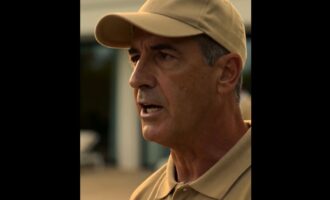
The morning was perfectly ordinary right up until I heard my husband shouting at his mother.
Dima rarely raised his voice. He was the calm one, the one who smoothed over conflicts with a tired smile and a joke. But that day his voice cut through the apartment like broken glass.
I was in our bedroom, folding laundry, when I heard him in the hallway.
“Mom, why are you saying again that Olya has someone else?” he yelled. “How many times are we going to do this?”
His mother’s voice answered, high and sharp, as if every word needed to pierce.
“I saw it, Dimochka. I’m not blind. She sneaks around, she hides her phone, she never looks you in the eye. I don’t want you to be fooled like your father was.”
I froze, clutching one of his shirts in my hands.
It wasn’t the first time I’d heard this tone from her, but it was the first time I heard her say it so clearly—I saw it. A fact. Not a suspicion. Not a feeling.
A lie.
For years, I had tried to love that woman. I told myself she was lonely. Bitter. Overprotective. A widow who loved her son too much and didn’t know what to do with that love. I tried to understand the way she criticized everything: the way I cooked, the way I cleaned, the way I breathed.
But accusing me of cheating?
That was a different level.
I stepped out into the hallway quietly. They were in the living room, backs turned to me, so neither noticed I was there.
Dima’s shoulders were tense. “You can’t just say things like that,” he snapped. “Olya works, she’s tired, she’s home every night. When would she even have time for someone else?”
Alina lifted her chin, her thin mouth tightening into a line. “I know women. Don’t be naïve. Your father was naïve too.”
There it was again. That vague threat. That eternal shadow: your father.
Dima’s father had died when he was a teenager. From what I knew, it was a heart attack. That was all his mother ever said. Any time he tried to ask more, she shut down, tears in her eyes, or would blow up and say, “You want to kill me too?” So eventually he stopped asking.
But she never stopped using him as a warning.
“Stop dragging Dad into every fight,” Dima said, running a hand over his face. “This has nothing to do with him.”
“It has everything to do with him,” she shot back. “You think betrayal just happens once in a family? It repeats. It runs in blood. She’ll leave you. And you’ll end up like him.”
I could see the way those words landed—like someone pressing on an open wound.
Dima turned away, his jaw clenched, and for a second I thought he might throw her out. Instead, he muttered something I couldn’t hear and walked past me toward the door, barely noticing I was there.
The door slammed.
Silence settled over the apartment.
Then my mother-in-law turned, and her gaze met mine.
For a moment, we just looked at each other.
“Did you hear enough?” she asked, almost calmly.
“More than enough,” I replied.
She shrugged, as if to say Good, then headed to her room, leaving me standing alone in a house that suddenly didn’t feel like mine.
That evening, when the sun sank and the apartment slipped into that blue, tired quiet, I decided to clean.
It wasn’t that the place needed it; I needed it. I needed something mechanical to do with my hands so that my mind didn’t shatter from replaying her words.
I started with the hallway, then the living room, then wandered, almost against my own will, toward her guest room.
Her room was always suffocatingly neat. Bed tucked tight, a little worn-out rug beside it, a dresser with a lace runner, and on top of it, a framed black-and-white photo of a much younger Alina next to a serious-faced man—Dima’s father, I assumed.
As I dusted the top drawer, the cloth snagged on something. A corner of paper, barely visible, was peeking out from behind a stack of old magazines.
Normally, I would’ve pretended not to see it.
That night, I didn’t.
I shifted the magazines aside and pulled out a thin, yellowed envelope. The edges were worn; the seal had long since cracked. It looked like it had been opened and read many times.
There was no address on the outside. No stamp. Just a single letter written where the recipient’s name should have been:
L.
Strange.
My heart beating faster, I opened the envelope and slid out a folded piece of paper. The handwriting on it was unmistakable—sharp, slanted, every letter drilled into the page with controlled pressure.
It was Alina’s.
I began to read.
“Dima must never know. He wouldn’t survive the truth… just like his father didn’t.
You and I, we know what really happened that night.”
My breath caught.
That night.
The phrase glowed on the page like something radioactive.
Dima had never told me anything about “that night.” Only that his father died suddenly. Only that his mother got “sick” afterward and that he had to grow up quickly. He carried his father’s death like a quiet, private scar.
My eyes moved down the page.
“If the truth comes out, he will blame himself. He always does. And you know how fragile he is.
I will carry this burden alone if I must.”
It sounded almost noble—I will carry this burden alone—but coming from her, it twisted in my chest.
At the bottom, there was no “Mom.” No “Alina.” Just a single initial:
A.
To L, from A.
And my husband—whose life, whose memories, whose marriage she gladly poisoned—was nowhere in that exchange. He was being discussed like a child, like a fragile thing to be managed and manipulated, not a grown man.
I flipped the page and something slipped out. A small photograph fluttered onto the bedspread.
It was old, colors faded, corners curling. In it, Alina—much younger, almost unrecognizable with loose hair and a laughing face—stood next to a man I did not know.
It wasn’t Dima’s father.
They were standing close, too close. Her hand rested on his chest, his arm around her waist. They looked… happy. Intimate.
A hot, metallic taste flooded my mouth.
Who was he?
Was this “L”?
Was this the person she had written to? The only one who “knew what really happened that night”?
Suddenly, all the accusations she’d thrown at me—every “I saw her,” every “she will betray you”—felt like projection. Like a desperate attempt to throw suspicion as far away from herself as possible.
My fingers trembled around the paper. I read the letter again, from the beginning, slower this time, searching for some detail I’d missed.
At the very top, in smaller handwriting, like a heading, was a date.
It was from the year Dima’s father died.
I don’t know how long I sat there with the letter in my hands.
By the time I came back to myself, the apartment was dark except for a dull light in the kitchen. I heard the front door open and Dima’s tired footsteps in the hallway.
“Olya?” he called.
“I’m in here,” I answered, my voice barely mine.
He walked in, frowning when he saw the envelope on the bed.
“What’s that?”
I held it out to him. “Something I found in your mother’s room.”
He took the papers from me, brows knitting deeper with every line he read. When he reached the part about his father, the color drained from his face. By the time he reached the signature, his hands were shaking.
He sat down heavily on the edge of the bed. For a moment, there was only the sound of the paper rustling.
“What… is this?” he whispered.
“It’s her handwriting,” I said quietly. “And the date… it’s from when your father died.”
He swallowed hard, eyes still locked on the letter.
“She always told me it was a heart attack. That he just… collapsed. That he was weak, that I shouldn’t ask questions because it would hurt her too much.”
“Maybe that was never the whole story.”
Dima let out a short, bitter laugh. “When is anything the whole story with her?”
He looked at me, and for the first time in years, I saw something clear in his eyes—not confusion, not guilt, not blind loyalty.
Anger.
“Why is it addressed to ‘L’?” he asked. “Who is ‘L’? Why was she writing to them about me and Dad? What really happened that night?”
“I don’t know,” I admitted. “That’s why we have to ask her.”
He inhaled slowly, as if bracing himself.
“And if she lies again?”
“Then you’ll know,” I said. “For once, you’ll really know.”
He stared at the letter one more time, folded it as carefully as if it were glass, and stood up.
“Let’s go,” he said.
We found his mother in the kitchen, sitting at the table with a cup of tea, the television murmuring softly in the background. She glanced up when we entered—first at Dima, then at me, then at the envelope in his hand.
Her eyes widened for a fraction of a second.
Then her face went still.
“What’s this?” Dima asked.
She tried to play dumb. “What?”
He placed the letter on the table between them.
“This.”
Her fingers tensed around the cup. “Where did you get that?”
“In your room,” I said. “Behind the magazines.”
She stared at the envelope like it was a snake.
“You were going through my things?” she snapped.
“I was cleaning your room,” I replied evenly. “If there’s something you want hidden, lock it. Don’t leave it behind a dusty TV guide from 2005.”
Dima didn’t smile. “Mom,” he said softly, “what is this letter? Who is ‘L’? And what does this mean—‘just like his father didn’t’ and ‘we know what really happened that night’?”
For a long moment, she didn’t answer. The ticking of the kitchen clock grew painfully loud.
Then she spoke, her voice suddenly hoarse.
“You were never supposed to see that.”
“Well, I did,” he said, the softness gone. “So now you’re going to explain.”
Her shoulders sagged, the fight draining out of her. She sank back into the chair like an old balloon losing air.
“Your father,” she began, eyes fixed on the table, “was a kind man. Too kind. Too trusting. He got involved with people who did not deserve his trust. Men who loaned money and then wanted more, always more.”
She took a shaky breath.
“He had debts. They grew. They threatened him. Threatened us.”
Dima’s face was unreadable. “You never told me that.”
“What good would it have done?” she shot back wearily. “You were a child. What would you have done? Paid them off with your school lunch money?”
She stared at the chipped edge of her teacup, then continued.
“That night… he came home late. He said he’d fixed it. Said we’d leave the city, start over, just us three. He was… excited. For the first time in months. But I knew men like that don’t just let you go.”
Her hands were shaking now.
“He told me to pack a bag. Said we’d take you and go. But you were running a fever, Dima. Do you remember? You were burning. I couldn’t drag you into the cold night, onto a train, not like that. I told him we’d leave in the morning.”
Her voice cracked.
“He left alone.”
She closed her eyes.
“They found him the next day outside the city. They said it was a heart attack. The police didn’t ask questions. Maybe they didn’t want to. I didn’t ask either. I’d seen enough.”
The room felt smaller with every word.
“And the letter?” I asked quietly. “Who is ‘L’? Who knew about all this?”
She hesitated, then sighed.
“My brother,” she said. “Leonid.”
I blinked. “You have a brother?”
Dima’s head snapped toward her. “You told me he died before I was born.”
Her lips twisted. “He did. To me, he did.”
It was a cruel answer, but there was more pain than venom in it.
“He was the only one who helped,” she continued. “He came when I called. Hid us for a while. Helped keep them away. He knew what your father had done, who he had borrowed from, what kind of people they were. That letter was for him. I didn’t know if they were watching the house, so I wrote only initials. I didn’t want your father’s name, or yours, or mine on it.”
“Why say Dad ‘didn’t survive the truth’?” Dima pressed. “What truth are you talking about?”
For the first time, Alina lifted her gaze and looked directly at him.
“The truth,” she said, “that he didn’t just leave because of them. He left… because he wasn’t sure he wanted to stay.”
Dima recoiled as if struck. “What?”
“He had someone else,” she said flatly. “Another woman. I found out. I confronted him that night. We screamed at each other. I told him if he walked out, he’d kill our family. He walked out anyway.”
She swallowed.
“Hours later, they called me. Said they’d found him. Said it was his heart. Maybe it was. Maybe it wasn’t. Maybe it was fear. Maybe it was guilt. Maybe it was those men. I don’t know. But I know he died running—not toward us, but away.”
Silence dropped over the room like a heavy curtain.
Dima’s eyes were wild, unfocused. “All this time… You told me he was a good man. A victim.”
“He was both,” she said quietly. “People are rarely one thing.”
He forced out a laugh that sounded like it hurt. “And you decided the best way to protect me from betrayal… was to spend years convincing me my wife was betraying me?”
Her face crumpled. “You don’t understand—”
“I understand perfectly,” he snapped. “You turned me into you.”
She flinched.
“You were so afraid of being hurt again,” he said, the words spilling now, “that you decided to see betrayal everywhere. In every woman. In Olya. In me. You poisoned our marriage because of a story you never even told me. You lied about Dad. You lied about your brother. You lied about everything, and you think I don’t understand?”
His voice broke on the last words, and suddenly he wasn’t a grown man anymore. He was a boy, left alone with a broken mother and half a story.
Alina reached out a trembling hand toward him, but he stepped back.
I watched them, my heart pounding, the letter still lying on the table like a piece of evidence.
“Who else knows?” I asked, cutting through the heavy silence. “About your husband. About the debts. About that night.”
She turned to me, and for the first time since I’d met her, she looked… afraid.
“Leonid,” she whispered. “And one other person.”
“Who?” Dima asked.
Her eyes flicked to the window. The curtains were drawn, but her gaze lingered there uneasily, as if expecting someone to be standing on the other side.
“The man who helped your father,” she said. “The one who introduced him to those people. He disappeared after your father died, but Leonid always said… he keeps an eye on us. That some debts never really end, just go quiet.”
A cold shiver ran down my spine.
“A watcher,” she murmured. “That’s what Leonid called him. Someone who never shows his face, but always knows where we are, how we live. To make sure we don’t talk. To make sure we don’t dig.”
Dima let out a short, bitter breath. “You’ve been living like this for twenty years?”
“Yes,” she said simply. “You think I stayed close to you just because I like the wallpaper in this city? I stayed because I didn’t know what would happen if I left. Or if you did. I thought if I kept you close, if I kept you suspicious, you’d never go too far. You’d never trust anyone too much. You’d never be weak… like him.”
Her eyes slid to me.
“And then you married her.”
My jaw tightened. “What exactly does that mean?”
“You ask questions,” she said. “You snoop. You look at everything with those eyes that say, ‘This isn’t enough, I want the whole truth.’ Women like me, we recognize women like you. You dig. So I made sure you’d be too busy defending yourself to go searching into the past.”
She said it almost calmly, as if she were explaining a clever recipe.
But my stomach turned.
“You lied to your son,” I said, keeping my voice low, because if I raised it I wasn’t sure what would come out. “You lied about your husband, your brother, your whole life. You let him grow up thinking betrayal was inevitable and women couldn’t be trusted, just so he wouldn’t ask the wrong questions.”
“Yes,” she said. “And I’d do it again.”
That was the moment something inside me snapped.
“Then you don’t get to call yourself a martyr,” I said coldly. “You weren’t protecting him. You were controlling him. There’s a difference.”
Dima was silent, staring at the floor as if the tiles had suddenly become very interesting, or very dangerous.
“Dima,” I said softly, “I didn’t cheat on you. I never have. The only person in this house who knows what betrayal really looks like—is standing right in front of you.”
His mother’s face twisted with pain. “You think your perfect little wife knows everything about betrayal? What do you know, girl? Have you buried a husband? Have you woken up every night wondering if the knock on the door is for you? Have you lived with men who don’t forget—”
“No,” I interrupted. “I haven’t. And I’m sorry for what you went through. I truly am. But your pain doesn’t give you the right to destroy everyone else’s life.”
Dima suddenly pushed back his chair. The legs scraped harshly against the floor.
“I need air,” he whispered.
He walked out of the kitchen and into the hallway, grabbed his jacket, and disappeared out the front door.
The sound of it closing was like a gunshot.
For a moment, I stood there, staring at the empty doorway.
Then I turned back to my mother-in-law.
We were alone.
She looked smaller somehow. Not because of her age, not because of the harsh light, but because she had no mask left. She had shown us everything, and none of it made her as strong as she wanted to be.
“You’re happy now?” she asked bitterly. “You’ve turned him against me.”
“I didn’t turn him against you,” I said. “You did that when you chose lies over trust. Years ago.”
Tears shone in her eyes, but she blinked them back stubbornly.
“You’re going to ruin him,” she said. “You and your questions and your truth. Men like him don’t survive truth. They barely survive love.”
I leaned my hands on the table and stared at her, really stared at her, until the rigid defenses in her gaze wavered just a little.
“I’m not going to ruin him,” I said quietly. “But I’m also not going to live in a marriage where your ghosts live in our bed. Where every time I go to the store, you wonder who I’m really meeting. Where every argument ends with ‘You’ll leave him like his father left me.’”
Her lips quivered at that last part.
“So what now?” she whispered.
“Now,” I said, “you have a choice. You can keep living in that night twenty years ago. Or you can admit that none of this was my fault. That I’m not your husband. That your son is not your second chance to fix the past.”
She let out a tired breath. “And if I don’t?”
“Then I will leave,” I said simply. “I won’t live with a woman who spends every day trying to convince my husband that I’m a monster. And if I leave, eventually, he will have to choose—between a marriage with me and a life chained to your fear.”
That finally broke her.
Her shoulders slumped, and for a second, she didn’t look like a villain. She looked like what she really was: a frightened, aging woman who had spent half her life fighting shadows and ended up punching holes in the people closest to her.
“I don’t know how to stop,” she whispered. “I don’t know how to live without… suspecting. Without waiting for the worst.”
“Then learn,” I said. “Or at least, don’t drag us down with you while you try.”
We sat in silence after that. The television hummed in the background, playing a show no one was watching.
I didn’t know how long Dima was gone. An hour, maybe two. Long enough for the tea in his mother’s cup to grow cold, long enough for the letters on the page to blur from being reread too many times.
When he finally returned, his face was pale but calmer. He took off his shoes slowly and came to stand in the kitchen doorway.
Alina sat up straight. “Dima—”
He raised a hand slightly. “No. Let me talk first.”
She fell silent.
He looked at me, then at her.
“I’ve spent my whole life,” he began, “trying to be the opposite of my father. Stable. Loyal. Predictable. I thought if I did everything right, I’d never repeat his mistakes. I’d never cause the kind of pain he caused.”
He swallowed.
“And because of that, I let myself be controlled. By fear. By guilt. By you, Mom. You made Dad into this… tragic story, and yourself into a saint. And I believed it because it was easier than believing he was human. Flawed. Secretive. Afraid.”
He looked at me, eyes shining.
“And I let your fear turn me against the one person who’s always been on my side.”
“Olya…” He took my hand. “I’m sorry. For every time I doubted you without saying it. For every time I let her words sit in my head and didn’t fight them hard enough.”
I squeezed his fingers, my throat tight.
He turned back to his mother.
“From today,” he said, “this stops. No more accusations. No more ‘I saw her,’ no more hints, no more poison. If you can’t live with us without turning every small thing into a betrayal, then you can’t live with us.”
Her mouth opened. “You’d throw me out?”
“I don’t want to,” he said. “You’re my mother. I love you. But I love my wife too. And I’m not going to lose her because you’re fighting ghosts.”
Tears slid openly down her cheeks now. “Where would I go?”
“We’ll help you,” he said. “We’ll find you a place. We’ll visit. We’ll talk. But it will be on new terms. And if you ever accuse her again without proof, if you ever try to make me choose with lies… then you will have made the choice yourself.”
She looked at him, at me, at the letter on the table.
For a moment, I thought she would explode. That she would scream, throw the cup, tear the letter into a thousand pieces.
Instead, her shoulders shook once. Twice. And then she covered her face and cried—not the sharp, manipulative tears I’d seen before, but deep, breaking sobs of someone mourning something they’d lost long ago.
Maybe her husband.
Maybe her son, as she’d imagined him.
Maybe the version of herself where she was always the victim and never the villain.
We didn’t touch her.
We let her cry.
Because sometimes, that’s the only way the past finally leaves your body.
That night, after she’d gone to her room, and after we’d quietly gathered the dishes and put away the letter in a drawer in our bedroom, Dima and I lay in bed, staring at the ceiling.
“Do you believe her?” I asked softly. “About the debts. The other woman. The watcher.”
He sighed.
“I believe she believes it,” he said. “I don’t know what’s true and what’s twisted by time and fear. Maybe my father did cheat. Maybe he didn’t. Maybe the men were worse than she says. Maybe they were just a convenient monster to blame. Maybe there is someone still watching us. Or maybe she just needed to believe that someone was, so she could justify never moving on.”
He turned his head to look at me.
“But I know one thing,” he continued. “I’m done letting her past write our future.”
I nodded, a small, fragile relief settling over me.
“What about the letter?” I asked. “What about Leonid?”
“We’ll decide what to do,” he said. “Maybe we’ll track him down. Maybe we’ll ask for his side. But not tonight.”
He took my hand again and brought it to his lips.
“Tonight,” he whispered, “I just need to be here. With you. In our life. Not in theirs.”
I shifted closer, resting my head on his shoulder, listening to the steady beat of his heart. For the first time in a long time, it felt like it was beating for us—not for a dead father or a grieving mother, not for old debts and old secrets.
Just for us.
Outside the window, the city hummed softly. Somewhere in that vast darkness, perhaps, there was a man who remembered a scared young widow and a dead debtor. Perhaps there was someone who once watched this family from the shadows.
But if he was still watching now, he would see something new.
Not a woman quietly swallowing accusations.
Not a son trapped between loyalty and fear.
But two people, finally, painfully, choosing each other over ghosts.
And a mother-in-law, behind a closed door, left alone with a secret that, at last, had lost its power.